
A list that changed its job
当用漢字 → 常用漢字
From kanji “for present use” to kanji “for common use.”
In November 1946 the government published the 当用漢字表: 1,850 characters, framed as the range to be used in public writing. It was a ceiling, set in the first year after the war.
In October 1981 it was replaced by the 常用漢字表: 1,945 characters and a different verb. The new list calls itself a 目安, a benchmark for laws, official documents, newspapers, magazines and broadcasting. Its preface says it does not reach into specialist fields or into how individuals choose to write, and that it does not overrule older texts.
The 2010 revision, the one in force today, added 196 characters and dropped five: 勺 錘 銑 脹 匁, including two old units of measure. The total is 2,136. One of the arrivals is 鬱, the second character of 憂鬱 (melancholy), a character dense enough that reading it is the realistic goal.
Where school fits
Schools teach a subset, grade by grade, under the 学年別漢字配当表. First grade gets 80: the numbers, sun and moon, mountain and river, eye, ear, hand and foot. The full elementary set is 1,026 characters under the 2017 curriculum, which added 20 characters used in prefecture names.
How to use the clip
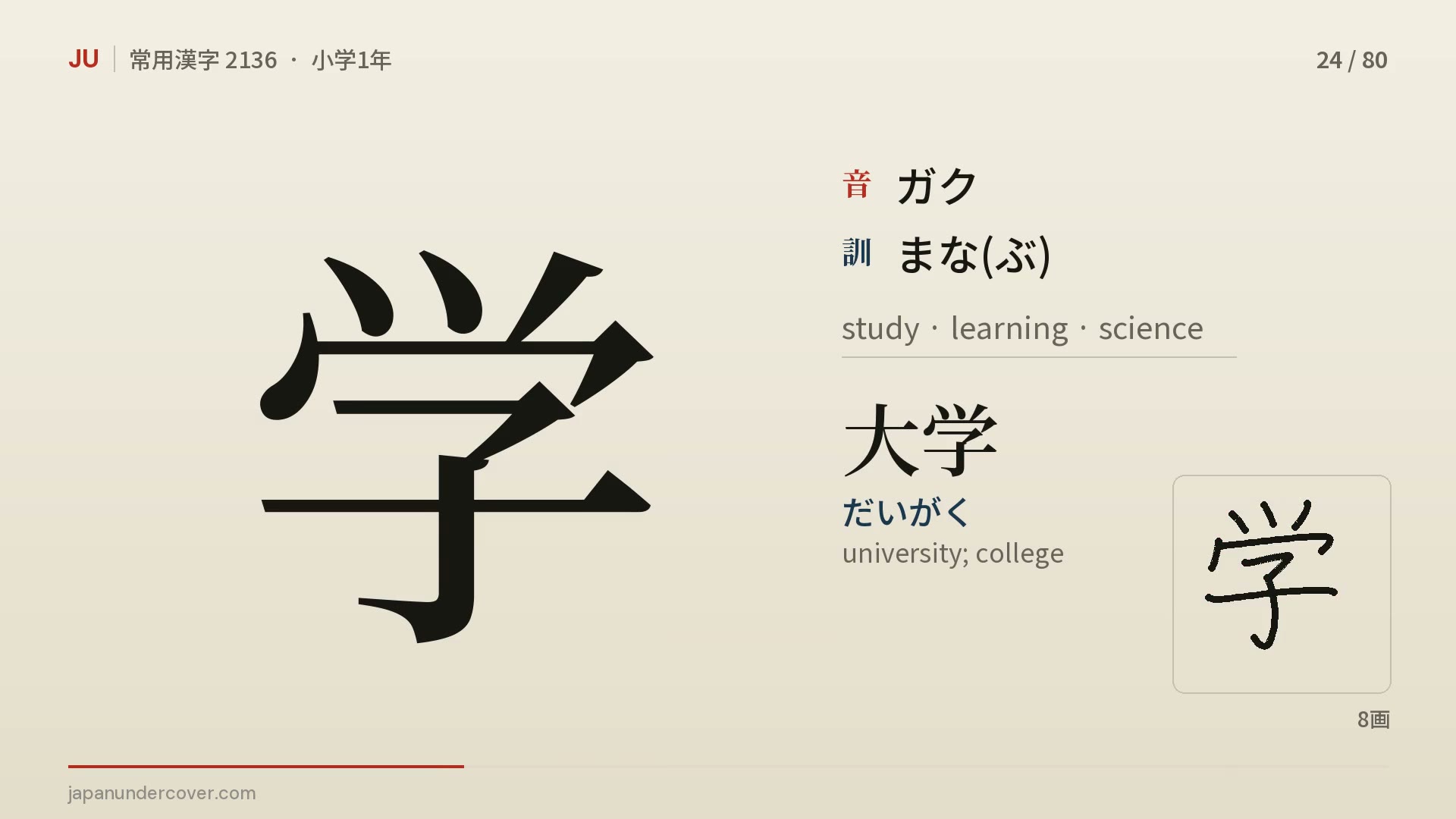
Each character appears alone for two beats. Say it before the voice does. Then come the readings: 音, readings derived historically from Chinese pronunciations, and 訓, native Japanese readings attached to the character. After that, an example word built only from characters you have already seen, and the stroke order drawn live.
Eighty characters in, you can already read 日本, 大学 and 小学生. These characters are a starting point for reading more words.