
A piece, not the whole
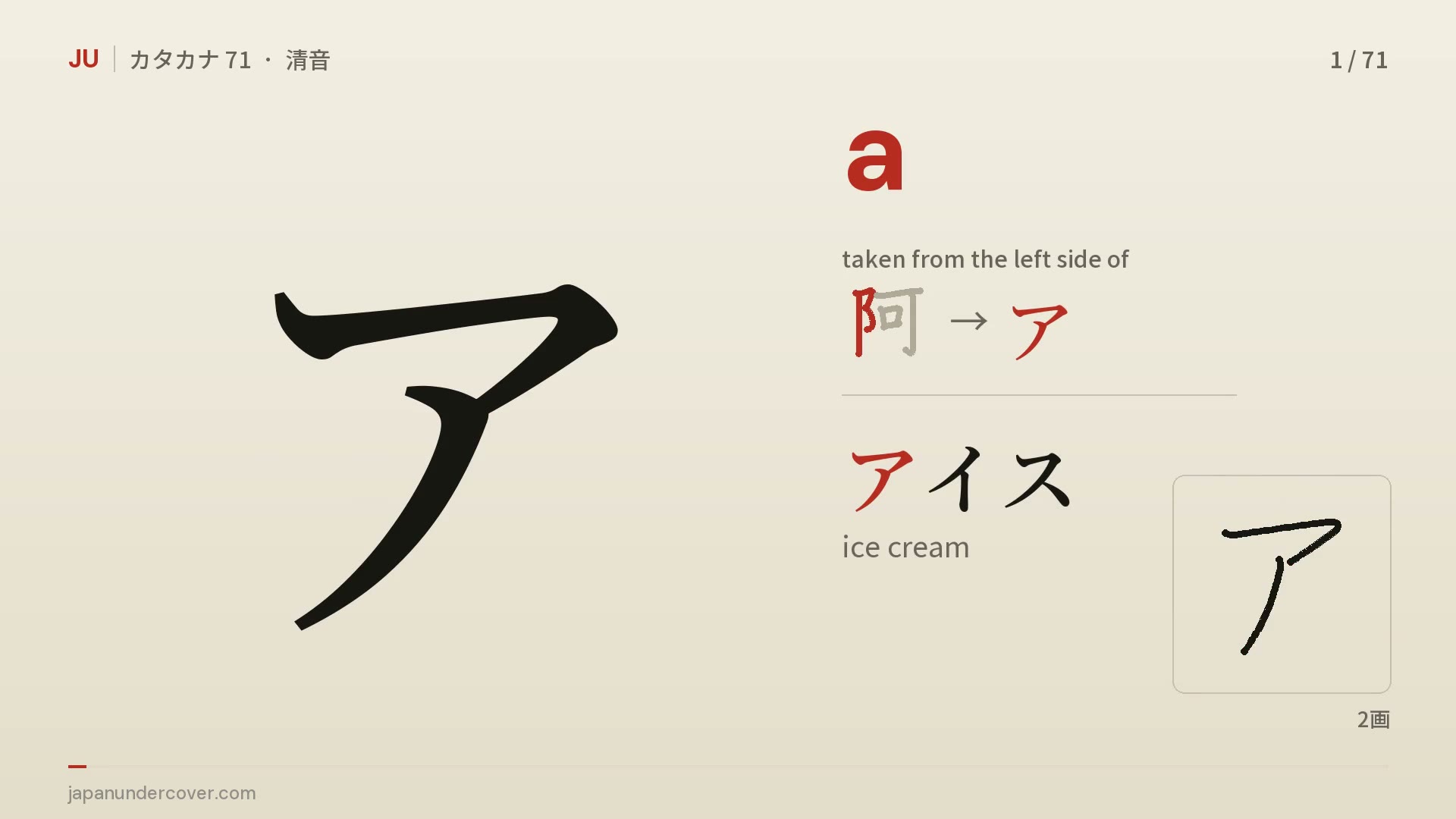
阿 → ア 加 → カ 利 → リ
Hiragana is a whole kanji in cursive. Katakana keeps a part.
The name says it: 片 means a piece, a fragment. Like hiragana, katakana come from 万葉仮名, kanji borrowed only for their sound. But instead of writing the whole kanji in cursive, the writers kept a side, a top or the first few strokes. 伊 gave its left side to イ, 宇 its top to ウ, 天 its first strokes to テ. A few simple kanji were kept almost whole: 千 → チ, 二 → ニ, 八 → ハ, 三 → ミ. A few, such as キ from 幾, came from a cursive form after all.
The clip draws each source kanji with the kept piece in red. These are the traditional explanations. Some scholars argue that the earliest katakana grew from brush forms, not printed kanji, so read the red piece as a guide, not a proof.
Where the sources disagree
For four katakana, the reference works part ways. マ is traced to 万 in one and 末 in another; ユ to 弓 or 由. For ツ, 州 is the most cited, with 門 and 津 also proposed. ン may not come from a kanji at all: one common view traces it to a mark used in reading notes. The clip says "sources differ" and draws no red piece for these.
A monks' shorthand
Katakana began in the early ninth century among scholar-monks of the Buddhist schools of Nara. To read Chinese scriptures in Japanese, they wrote small sound marks beside the characters, and a few strokes of a borrowed kanji were quicker than the whole. The shapes varied by person and school for a long time and settled close to today's by about the twelfth century. The story that the scholar Kibi no Makibi invented katakana is not accepted by modern dictionaries.
One shape per sound, from 1900
The same 1900 school rules (小学校令施行規則) that fixed hiragana in field note 010 fixed katakana too: one shape per sound. After the kana reform of 1946, ヰ and ヱ fell out of ordinary use, and ヲ survives only as the particle, as in the old katakana-only style ホンヲ ヨム, read a book.
What katakana is for now
Mostly words from other languages: アイス, テレビ, ホテル. Also foreign names, sound words, emphasis, and the Japanese names of plants and animals in science writing, which is why the clip writes goat as ヤギ and elephant as ゾウ. Two voiced kana are rare: ヂ shows up in a few words such as チヂミ, and ヅ has no everyday word, so the clip shows it bare. One extra mark, ヴ, writes a foreign v. It was Fukuzawa Yukichi's idea and the government accepted it in 1991, but it is not one of the 71, and many words still use バ, ビ and ブ instead.
When children learn them
The national curriculum puts hiragana and katakana in the same grade 1 and 2 band: children learn to read and write both, and which kinds of words are written in katakana.
How to use the clip
Each katakana appears alone for two beats; say it before the voice does. Then come its sound, the kanji it came from with the kept piece in red, an everyday word with the kana in red, and the stroke order. The 25 voiced kana follow the 46: two small marks turn カ into ガ and ハ into パ.
142 kana down. Next: the kanji.