
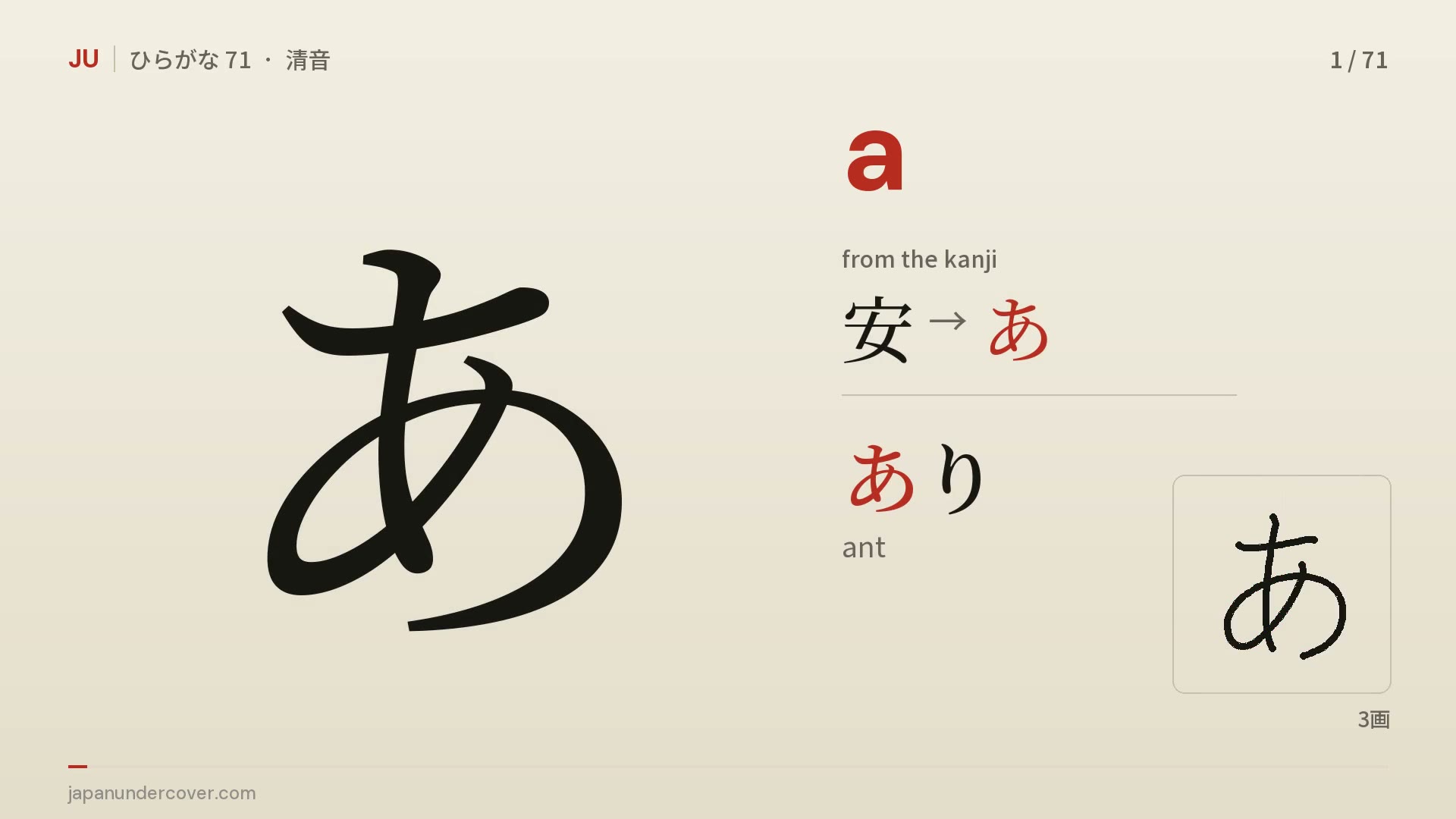
A kanji, written fast
安 → あ 以 → い 奴 → ぬ
Every hiragana is a kanji in cursive, worn down.
Hiragana grew out of 万葉仮名, kanji borrowed only for their sound. Written in cursive again and again, they simplified into the shapes children learn now: 安 became あ, 以 became い, 奴 became ぬ. The clip shows the kanji each kana is usually traced to.
The tracing is not always tidy. Scholars note that the exact path from cursive kanji to kana resists a clean explanation, and for つ the sources differ: one table gives 川, another 州. The clip shows both.
One shape per sound, from 1900
For centuries a sound could be written with several kana, each from a different kanji. On August 21, 1900, the Ministry of Education's rules for elementary schools (小学校令施行規則) fixed the kana to be taught in a single table, with 48 hiragana. Only those shapes were taught from then on. The others fell out of use and are now called 変体仮名, variant kana.
Two retired in 1946
48 became 46 after the war. The 1946 kana rules (現代かなづかい, Cabinet Notice No. 33) wrote ゐ and ゑ as い and え. The same rule wrote を as お, with one exception: the particle. That is why を survives in a phrase like ほんを よむ, read a book, and nowhere else in modern spelling. The current rules, from 1986, keep the exception.
When children learn them
The national curriculum puts hiragana and katakana in its grade 1 and 2 band: children learn to read and write both, and which words are written in katakana. In the same band, first graders start on the 80 kanji of field note 007.
How to use the clip
Each kana appears alone for two beats; say it before the voice does. Then come its sound, the kanji it came from, an everyday word with the kana in red, and the stroke order. The 20 voiced and 5 semi-voiced forms follow the 46 basic kana. Two small marks (dakuten) turn か into が; a small circle (handakuten) turns は into ぱ.
71 down. Next: the kanji.