
Read the handoffs
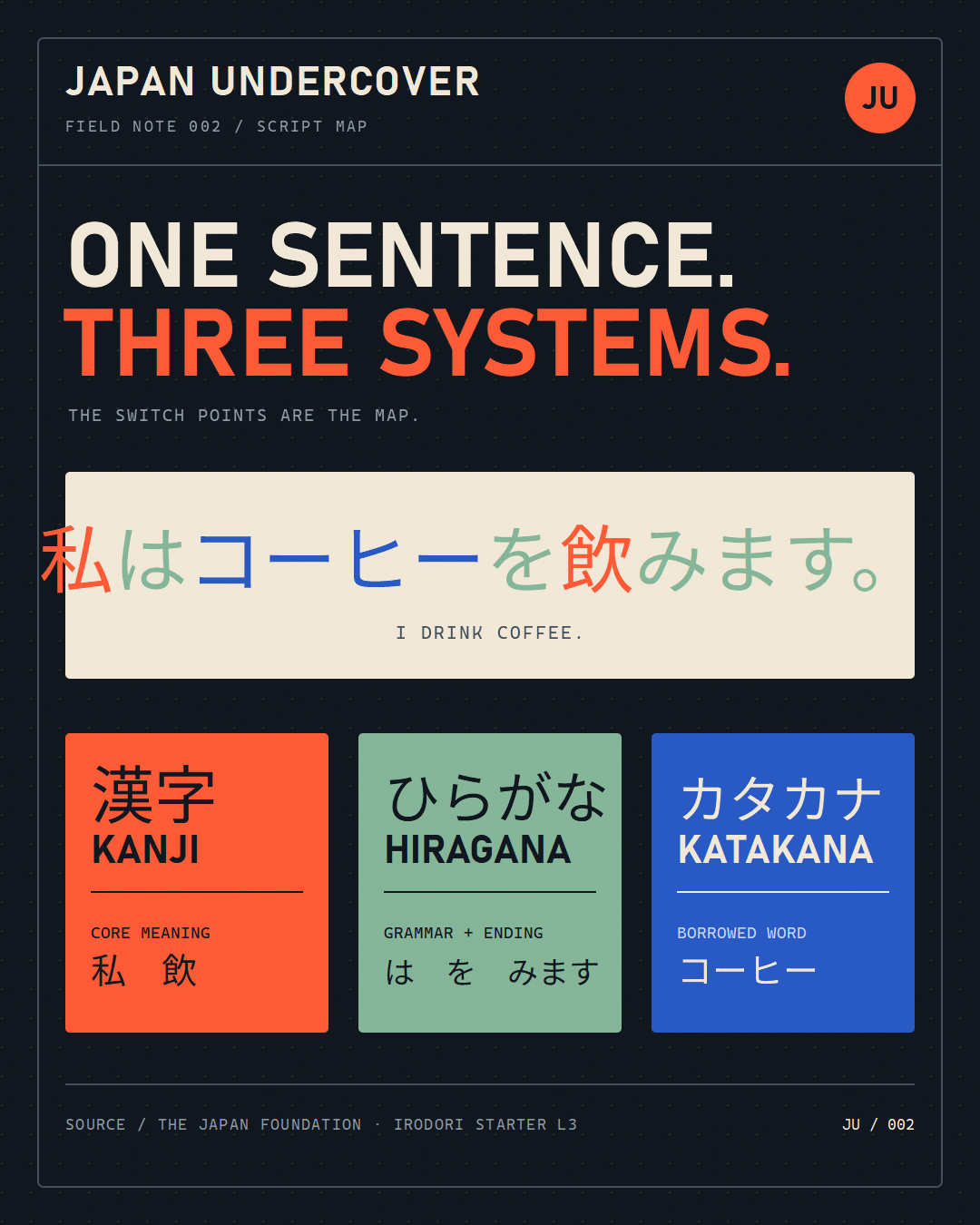
私はコーヒーを飲みます。
I drink coffee.
Kanji carries much of the sentence's lexical meaning: 私 gives “I,” while 飲 anchors “drink.” Hiragana supplies particles and inflection: は, を, and みます. Katakana marks the borrowed word コーヒー, coffee.
Why this helps beginners
A new learner often sees an undifferentiated wall. A practiced reader sees category changes. Katakana suggests a loanword. Hiragana around kanji often reveals grammar or a word ending. Kanji compresses meaning.
The more accurate description
These are three writing systems, not three alphabets. Japanese also uses the Latin alphabet in some settings, but ordinary sentences routinely combine kanji, hiragana, and katakana.